The Dawn of a New Intelligence Era
Artificial intelligence has undergone a seismic shift in recent years, and at the forefront of this transformation stands Claude, Anthropic's flagship AI model. Since its initial release, Claude has steadily evolved from a capable conversational assistant into a multi-dimensional intelligence platform that is redefining what AI can accomplish in the real world. As of 2026, the Claude model family — which includes Claude Opus 4.6 and Claude Sonnet 4.6 — represents one of the most advanced and safety-aligned AI systems ever built. The journey from early language models to today's Claude is nothing short of revolutionary, encompassing breakthroughs in reasoning, memory, multimodal understanding, and ethical AI design. Anthropic's relentless focus on safety and helpfulness has produced an AI that is not only powerful but also trustworthy — a balance that has proven elusive in the broader industry. Organizations across sectors including healthcare, law, finance, education, and software engineering are now integrating Claude into their daily workflows, unlocking levels of productivity and creativity previously unimaginable. This blog post explores the key developments behind Claude's rise, the technical innovations driving its capabilities, and the profound implications it holds for humanity's relationship with artificial intelligence. Understanding this revolution is no longer optional for anyone invested in the future of work, technology, or society.
The Architecture Behind Claude's Brilliance
Claude is built on a sophisticated large language model (LLM) architecture that combines transformer-based deep learning with carefully curated training methodologies. What distinguishes Claude from many of its peers is Anthropic's use of Constitutional AI (CAI) — a training technique that embeds a set of principles directly into the model's learning process, guiding it to be helpful, harmless, and honest without relying solely on human feedback. This architectural philosophy means Claude is not just optimized for raw performance but is designed to reason ethically and contextually, even in ambiguous or high-stakes scenarios. The model's attention mechanisms allow it to maintain coherence across extremely long documents and conversations, making it invaluable for complex, multi-step tasks. Claude's context window — which has expanded dramatically over successive versions — enables it to process entire codebases, lengthy research papers, legal contracts, and detailed project briefs in a single session. The training data pipeline at Anthropic is meticulously curated to reduce bias, misinformation, and harmful outputs, resulting in a model that is substantially safer than earlier AI systems. Under the hood, Claude also leverages reinforcement learning from human feedback (RLHF), which fine-tunes its outputs to align with nuanced human preferences and professional standards. The interplay of these technical components creates an AI that feels remarkably intuitive, thoughtful, and context-aware — qualities that are driving its adoption across virtually every knowledge-intensive domain.
Claude's Evolving Model Family: Opus, Sonnet, and Haiku
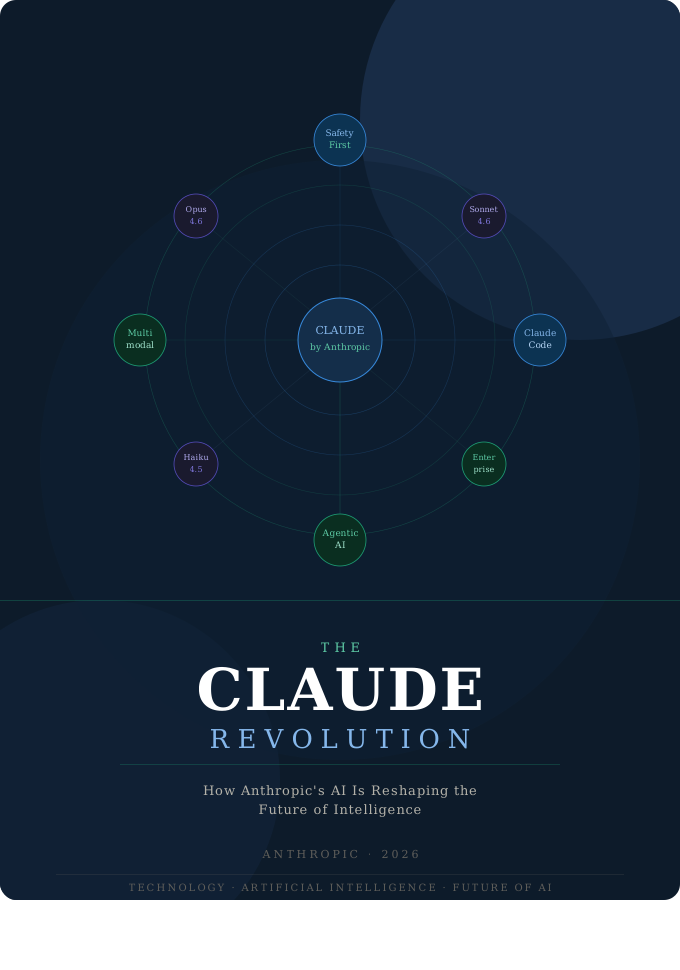
One of the most strategic decisions Anthropic has made is structuring Claude as a tiered model family, giving users and developers the ability to choose the right balance of capability and efficiency for their specific needs. At the top of the hierarchy sits Claude Opus 4.6, a powerhouse model designed for the most demanding intellectual tasks — from advanced scientific research and complex legal analysis to sophisticated software architecture and strategic business consulting. In the middle is Claude Sonnet 4.6, a smart, efficient model optimized for everyday use that strikes an excellent balance between intelligence and speed, making it ideal for businesses and professionals who need high-quality AI assistance at scale. Rounding out the family is Claude Haiku 4.5, a lightweight model built for speed and cost efficiency, perfect for applications requiring rapid responses and high-volume processing. This tiered approach reflects a deep understanding of the market: not every use case demands the full computational weight of Opus, and offering diverse options has dramatically expanded Claude's accessibility. The naming convention itself — Opus for peak performance, Sonnet for harmony and balance, Haiku for elegance and brevity — reflects Anthropic's thoughtful brand philosophy. Each model shares the same foundational safety principles and ethical guardrails, ensuring that regardless of which version is deployed, users can trust the outputs.
Claude as a Developer Platform: API and Claude Code
Beyond its consumer-facing interface, Claude has emerged as a robust developer platform that is enabling a new generation of AI-powered applications. The Claude API gives developers programmatic access to the full power of the model family, allowing them to build everything from intelligent customer service bots and document automation tools to medical diagnostic aids and creative writing platforms. Claude Code — a dedicated command-line tool — positions Claude as an agentic coding partner capable of understanding entire repositories, writing and editing code, debugging errors, and autonomously executing multi-step software development tasks. This represents a fundamental shift in how developers interact with AI: rather than asking a chatbot for code snippets, engineers now have a collaborator that can reason about architecture, navigate complex codebases, and operate with a degree of autonomy previously reserved for senior human developers. The Model Context Protocol (MCP), introduced by Anthropic, further extends Claude's capabilities by allowing it to connect with external tools, databases, and services in a standardized way, making it the connective tissue of modern AI workflows.
Safety as a Core Innovation: Constitutional AI and Beyond
What truly sets Claude apart in the crowded AI landscape is Anthropic's unwavering commitment to safety as a first-class engineering priority, not an afterthought. Constitutional AI teaches the model to evaluate and revise its own responses against a set of guiding principles, covering everything from avoiding harm and respecting user autonomy to providing accurate information and handling sensitive topics with care. The result is a model that is substantially less likely to produce toxic, misleading, or dangerous content than models trained without such guardrails. Anthropic has also invested heavily in interpretability research — the science of understanding what is actually happening inside a neural network — publishing groundbreaking findings about how large language models represent and process information. Claude's safety architecture is adaptive: the model is designed to handle ambiguous requests thoughtfully, seeking clarification when needed rather than defaulting to either harmful compliance or unhelpful refusal. As AI systems become more powerful and more autonomous, this principled safety engineering will become increasingly critical to ensuring that advanced AI benefits humanity as a whole.
Claude in the Enterprise: Transforming Industries
The enterprise adoption of Claude has been nothing short of remarkable, with organizations across virtually every major industry finding transformative applications for the technology. In the legal sector, law firms are using Claude to review and summarize contracts, conduct legal research, and draft briefs at a speed that would be impossible for human teams alone. In healthcare, Claude is assisting with clinical documentation, patient communication, and medical literature review — all while adhering to strict privacy and accuracy standards. Financial institutions are deploying Claude for risk analysis, regulatory compliance, and real-time customer support. The education sector has embraced Claude as a personalized tutor capable of adapting to individual student needs, generating custom curriculum materials, and providing detailed feedback on essays. In the creative industries, writers, marketers, game designers, and filmmakers are using Claude as a creative collaborator for brainstorming, scriptwriting, and editorial work. The breadth of enterprise use cases reflects not just Claude's raw capability, but its adaptability and domain-specific contextual sensitivity.
Multimodal Frontiers: Seeing, Reading, and Understanding the World
Claude's evolution into a multimodal AI system represents one of the most exciting frontiers in its development, expanding its capabilities far beyond text-based interaction. With the ability to process images, documents, charts, and visual inputs alongside text, Claude can now assist with tasks that were previously beyond the reach of language models. Architects can share blueprints and receive detailed technical feedback; doctors can upload medical imaging reports for analytical support; data analysts can provide complex charts and receive insightful interpretations. The integration of vision capabilities also enables powerful document processing workflows: Claude can read scanned PDFs, extract structured data from forms, and analyze infographics. As enterprises increasingly deal with unstructured data in multiple formats, Claude's multimodal capabilities position it as a truly comprehensive intelligence platform.
Agentic AI: From Assistant to Autonomous Actor
Perhaps the most consequential development in Claude's recent evolution is the emergence of agentic capabilities — the ability to not just answer questions but to plan, decide, and act autonomously on complex, multi-step tasks. Agentic Claude can browse the web for current information, write and execute code, manage files, interact with external APIs, and chain sequences of actions to complete sophisticated workflows with minimal human intervention. Products like Claude Code, Claude in Chrome, Claude in Excel, and Cowork represent the practical manifestation of this agentic vision. Tasks that once required hours of human effort — research synthesis, data processing, report generation, software testing — can now be delegated to Claude, freeing human workers to focus on higher-order strategic and creative work. Anthropic's approach to agentic safety is cautious and principled: Claude is designed to seek human confirmation for consequential actions and maintain transparency about what it is doing and why.
The Competitive Landscape and Claude's Unique Position
The AI industry in 2026 is intensely competitive, with OpenAI's GPT series, Google's Gemini, Meta's LLaMA, and specialized models all vying for market share. Within this landscape, Claude has carved out a distinctive position defined not just by performance benchmarks but by a coherent philosophy of safe, honest, and beneficial AI. While competitors have often prioritized rapid feature releases, Anthropic has consistently emphasized building models that are genuinely trustworthy and predictable across a wide range of situations. This commitment has resonated strongly with enterprise customers, regulated industries, and institutional users who need AI systems they can depend on in high-stakes environments. Anthropic's academic research output, including landmark papers on Constitutional AI, interpretability, and scaling laws, has further solidified Claude's reputation as not just a product but a contribution to the foundational science of AI.
The Future of Claude: Toward Transformative and Beneficial AI
Looking ahead, the trajectory of Claude's development points toward AI systems of extraordinary capability and profound societal impact. Anthropic's long-term research agenda includes advances in reasoning, memory, planning, and multi-agent collaboration that could eventually produce AI systems capable of conducting original scientific research, developing new medicines, and solving complex global problems. Future versions of Claude are expected to exhibit even greater contextual understanding, more nuanced ethical reasoning, and richer collaboration capabilities, gradually expanding the frontier of what AI can contribute to human knowledge and well-being. The Claude revolution is not just a story about a remarkably capable AI — it is a story about the choices humanity is making, right now, about the kind of artificial intelligence we want to build and the kind of future we want to live in.