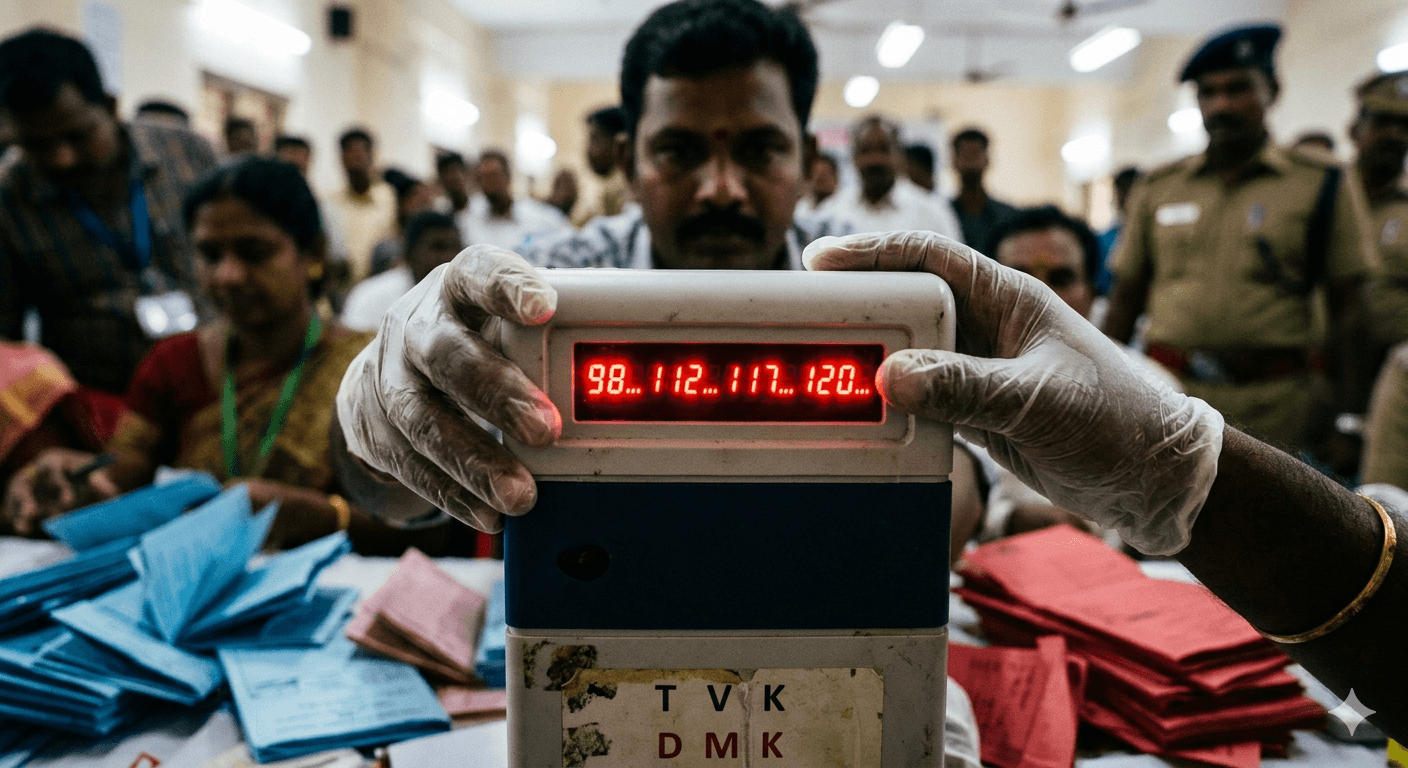
The political landscape of Tamil Nadu has long been characterized by grand declarations, towering cut-outs, high-decibel propaganda, and the inevitable rebranding of welfare schemes with every change in governance. For decades, the Dravidian political duopoly operated on a specific blueprint of visible, loud assertion. However, the dawn of May 2026 brought a paradigm shift that few seasoned political analysts fully anticipated. When actor-turned-politician Thalapathy Vijay and his party, the Tamilaga Vettri Kazhagam (TVK), assumed the mantle of power, critics and supporters alike wondered how a cinematic icon would translate his larger-than-life screen persona into the gritty, complex world of administrative governance.
The answer came not through a burst of media campaigns or celebratory state-sponsored advertisements, but through a quiet, calculated, and profoundly simple approach to statecraft. Sitting in the Chief Minister's chair, Vijay has systematically dismantled the traditional expectations of political showmanship. Instead of spending his early days in office conducting massive public relations exercises or building monuments to his party’s historic debut victory, he has quietly retreated into the engine room of the Secretariat. By choosing a path of absolute simplicity and avoiding the typical traps of political vanity, the new Chief Minister has shown that his administration is playing in an entirely different league—one where silent performance speaks vastly louder than loud publicity.
This silent revolution is reshaping the relationship between the citizen and the state in Tamil Nadu. By intentionally keeping the focus away from personal adoration and directing it entirely toward institutional efficiency, the TVK administration has established a unique governance model. Bureaucratic circles report a noticeable shift in the work culture at Fort St. George, where files are moving without the usual political fanfare and media entourages. This understated, work-first methodology has sent a powerful message across the state: the era of symbolic politics is giving way to an era of substantive governance, where the welfare of the common man takes absolute precedence over the brand equity of the ruling party.
1. Unshakable Continuity: Prioritizing People Over Political Ego
One of the most deeply entrenched traditions in Indian politics is the immediate dismantling or renaming of the previous government’s flagship welfare schemes upon a change in power. This practice, driven entirely by political ego and the desire to erase the legacy of a predecessor, often inflicts massive disruptions on the poorest segments of society who rely on these lifelines. Chief Minister Vijay, however, shocked the political establishment by doing the exact opposite. From his first week in office, he gave strict instructions to the bureaucracy that all existing welfare schemes aimed at women and students initiated by the previous DMK government must continue without a single day of interruption, modification, or cosmetic rebranding.
For the women of Tamil Nadu, this meant that vital support structures like the *Kalaignar Magalir Urimai Thogai* (the monthly financial assistance scheme for women heads of households) and the free bus travel initiative remained completely secure. Instead of wasting public funds to change the names on the application forms or replace the imagery on government portals with TVK branding, the administration quietly ensured that the financial deposits hit bank accounts on time. For millions of women managing tight household budgets in a challenging economic climate, this continuity provided immense relief. It proved that the new Chief Minister viewed these funds not as political charity, but as an absolute right of the citizens, irrespective of which party's leader originally signed the executive order.
Similarly, in the educational sector, the TVK government has protected and sustained critical student welfare initiatives, including the *Pudhumai Penn* scheme, which provides financial assistance to government school girls pursuing higher education, and the *Tamil Pudhalvan* scheme for boys. By allowing these programs to run smoothly alongside the popular breakfast scheme in primary schools, the administration has shielded the student community from the chaotic transitions that typically follow an election. Vijay’s refusal to indulge in political revisionism has established a refreshing benchmark in governance. It demonstrates a rare maturity that values human development over party propaganda, ensuring that the youth and women of the state are never used as pawns in a battle of political legacies.
2. A War in the Shadows: Confronting the Drug Menace with Iron Discipline
The rising influx and consumption of narcotics among the youth has emerged as one of the most pressing socio-economic threats to Tamil Nadu's future. Recognizing that a generation caught in the grip of addiction cannot contribute to the state's growth, Chief Minister Vijay has launched an uncompromising, aggressive war against the drug flow between youngsters. However, true to his established style of governance, this campaign is completely devoid of standard political photo-ops, televised police raids, or self-congratulatory press conferences. Instead, the TVK administration has chosen to wage this battle in the shadows, focusing on deep structural overhauls, intelligence-driven policing, and cutting off the financial supply lines of international and domestic drug cartels.
At the heart of this strategy is a massive, covert intelligence operation that bypasses traditional, localized police channels which are sometimes vulnerable to political interference. The Chief Minister has directly empowered a specialized, high-level task force within the state's Cyber Crime and Anti-Narcotics wings, giving them total administrative autonomy to track down supply chains on the dark web and monitor smuggling routes across coastal borders. By prioritizing data-driven surveillance over dramatic street-level arrests of minor peddlers, the state is systematically dismantling the high-level networks that profit off the vulnerability of young students. Educational institutions have been cordoned off with invisible security blankets, where undercover operatives work in tandem with campus administrations to map out and neutralize local distribution rings.
Furthermore, this anti-drug campaign goes beyond mere law enforcement; it treats the issue as a critical public health crisis. The TVK government has quietly initiated the setup of state-of-the-art, completely free rehabilitation and psychological counseling centers adjacent to government hospitals, ensuring that afflicted youngsters can seek medical intervention without the fear of social stigma or legal retribution. By focusing heavily on demand-reduction through silent awareness programs in schools and colleges, while simultaneously choking the supply through ruthless legal enforcement, the administration is tackling the root causes of the crisis. This disciplined, non-publicized approach is winning the trust of anxious parents across the state, who see a leader genuinely invested in saving their children's lives rather than scoring cheap political points in the media.
3. Immediate Justice: Transforming Women’s Safety Within 72 Hours of Power
If there was an event that definitively proved the TVK administration’s commitment to urgent, actionable governance, it was the sweeping structural changes introduced on the Chief Minister's very third day in office. Women's safety has frequently been treated as a rhetorical talking point during election campaigns, only to be relegated to slow-moving bureaucratic committees post-elections. Breaking this cycle of delay, Chief Minister Vijay signed a series of executive orders on his third day that completely revolutionized how the state handles crimes against women. By implementing hyper-localized "Women Safety Stations" and establishing an inflexible protocol for high-priority cases, the administration has sent an undeniable shockwave through the state's law enforcement apparatus.
These newly mandated Women Safety Stations are designed as specialized, secure zones within existing police precincts, staffed entirely by trained women police officers, legal counselors, and medical professionals. The objective is to eliminate the severe psychological barrier and intimidation that victims often experience when entering a standard, male-dominated police station to file a complaint. Under the strict new directives issued directly from the Chief Minister's Office (CMO), any grievance registered at these stations regarding sexual harassment, domestic violence, or digital stalking is immediately classified under a "High Priority Category." This classification completely strips the local police of the discretionary power to delay or dilute the case, ensuring an immediate institutional response.
The defining feature of this reform is the mandatory timeline imposed by the TVK government: an investigation must be launched, and a comprehensive Action Taken Report (ATR) must be filed directly to a centralized tracking portal within 24 hours of the complaint. By introducing a digital monitoring system that alerts top-tier bureaucrats if a case lies dormant for more than a day, Vijay has successfully brought structural accountability to the police force. The message to perpetrators is loud and clear, despite being delivered without media fanfare: the state will act with brutal efficiency and speed to protect its women citizens. For the female population of Tamil Nadu, this lightning-fast implementation on Day 3 provided immediate reassurance that their security is the cornerstone of this new political era.
4. Healing the Fractured Legacy: The Quiet Reconstruction of AMMA Canteens
Perhaps the most emotionally resonant and politically significant act of the TVK administration has been its approach toward the *Amma Unavagam* (Amma Food Hotels) scheme. Originally launched by the late Chief Minister J. Jayalalithaa of the AIADMK, these low-cost canteens served as an absolute lifeline for urban poor, daily wage laborers, migrant workers, and struggling students by providing hygienic, hot meals for as low as one rupee. However, following subsequent changes in power, these canteens frequently faced severe political neglect, budget cuts, and deliberate attempts at marginalization because they bore the political identity of an opposition icon. In a move that deeply touched the hearts of the working class, Chief Minister Vijay ordered the immediate, comprehensive renovation and reconstruction of all struggling Amma Canteens across the state—without changing a single letter of their original name.
This decision to completely eschew rebranding is virtually unprecedented in the history of Tamil Nadu politics, where millions of rupees of taxpayers' money are routinely spent just to replace names and logos on public infrastructure to satisfy party egos. The TVK government chose to channel those financial resources directly into upgrading the quality of food, restoring dilapidated canteen buildings, improving sanitation standards, and ensuring regular, uninterrupted supply chains for the kitchens. By leaving the name "Amma" intact, Vijay demonstrated an exceptional level of political nobility and empathy, recognizing that a welfare scheme that feeds the hungry should never be subjected to ideological vandalism or partisan pettiness.
The impact of this quiet reconstruction has resonated deeply among the state's youth, the middle class, and the marginalized workforce. In a time of rising inflation, the revival of these canteens has brought tangible economic relief to thousands who can now access dignified, affordable meals in a clean environment. The working-class communities have responded with immense gratitude, noting that the new Chief Minister has chosen to honor the positive elements of past administrations rather than waste time settling old political scores. By prioritizing the hunger of his citizens over the visibility of his own party’s banners, Vijay has redefined political grace in Tamil Nadu, solidifying his position as a leader who rules not for the headlines but for the people.
TVK Vijay (CM of TN) Plays Their Own League Without Publicity, With Simplicity
Loading comments...